Sunday, August 30, 2009
August 30, 1986: Shirley Booth was born

Saturday, August 29, 2009
August 29, 1896: Origin of Chop Suey

Friday, August 28, 2009
August 28, 1917: Jack Kirby was born on the Suffolk Street!

Thursday, August 27, 2009
August 27, 1776: The Battle of Long Island

Wednesday, August 26, 2009
August 26, 1970: Women's Equality Day

On January 9th, 1918, President Wilson announced his support for the suffrage, followed by the passing of Susan B. Anthony Amendment in the congress the next day. On June 4th 1919 the senate passed the amendment by one vote. Finally, On August 26th, 1920, the Amendment became the Nineteenth Amendment to the Constitution, after Tennessee became the 36th state to ratify.
On the fiftieth anniversary of the Nineteenth Amendment, August 26th, 1970, over 20,000 marchers gathered on the streets of Manhattan to demonstrate for equal rights for women. It was the largest women's rights rally since the suffragists, and the Strike succeeded beyond expectations. As the marchers gathered in Battery Park and marched down the Fifth Avenue, thousands gathered in Washington D.C. to walk down the Connecticut Avenue in demonstration. In L.A., 500 marchers gathered to march down, although confined to the sidewalk. Among the leading marchers were Gloria Steinem, a journalist and founder of the New York Magazine and social and political activist; Betty Friedan, a primary founder and the first president of the National Organization for Women, also the author of The Feminine Mystique; and congresswomen Bella Abzug, who a year later securely declared August 26th as the 'Women's Equality Day'. ☆
Jin Shin, EVHP Staff
Tuesday, August 25, 2009
August 25, 1835: The Great Moon Hoax

On August 25th 1835, this eye-catching headline was printed on the New York Sun:
GREAT ASTRONOMICAL DISCOVERIES
LATELY MADE
BY SIR JOHN HERSCHEL, L.L.D. F.R.S. &c.
The article described various fantastic lifeforms on Moon, such as bison, unicorns, goats, winged humanoids building temples and more. Forests and oceans were observed, under a supposed 'new principle' and 'telescope'. Supposed narrator was Sir Andrew Grant, describing himself as the companion of, then the most influential astronomer, Sir John Herschel.
The Great Moon Hoax, appearing in six articles on the New York Sun starting on August 25th, drew the New York Sun paper circulation higher than ever, and established the paper as a successful paper. The New York Sun never issued a retraction, and enjoyed its high circulation. The supposed discoverer of these fantastic animals, Sir John Herschel, was at first amused by these articles; however, was annoyed by a few who took the hoax as serious.
Richard A. Locke, a Cambridge-educated reporter, is attributed to the authorship of this article. While working for the New York Sun in 1835 he never publically admitted his authorship. Some others were also speculated to be involved in these articles, but there is no good evidence that indicated anyone but Locke was the author of the story. What was his reason for writing the articles? Probably to increase the paper circulation, or to ridicule some extravagant astronomical theories of the time, some say. Whichever was his reason, the author was extremely successful in both ways. ☆
Jin Shin, EVHP Staff
Monday, August 24, 2009
August 24, 1857: The New York Branch of the Ohio Life Insurance and Trust Company Failed
On August 24, 1857, the New York Branch of the Ohio Life Insurance and Trust Company failed due to widespread embezzlement, precipitating the Panic of 1857. Following this large trust company’s collapse, New York banks placed restrictions on transactions. Investors interpreted the restrictions as signs of an impending economic disaster and withdrew as much of their money as they could.
The Panic of 1857 contributed to a sharp economic downturn that lasted for eighteen months and spread to Europe and the Middle East. Other factors that contributed to the larger downturn included the failure of the overbuilt railroads and the sinking of the SS Central America, a large steamship carrying 30,000 pounds of gold intended for eastern banks. The loss of so much gold the second major blow to a financial system where banks still dealt in specie. Economic recovery was slow and uneven and was not complete until the United States had entered the Civil War.
Laurel Billings, EVHP Staff
Sunday, August 23, 2009
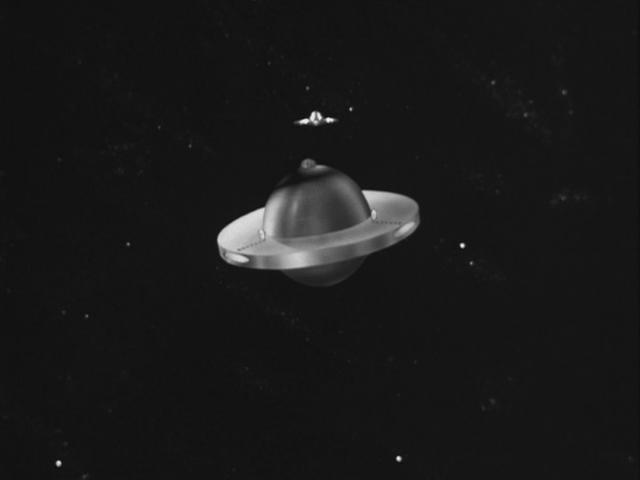
August 23, 1974: John Lennon saw a UFO in New York City
The fine print on John Lennon’s album “Walls and Bridges” sparked quite the commotion in the UFO "research" community—and no-doubt little smiles on the faces of millions of fans. Turning past the front cover, decorated with the marker drawings of an eleven-year-old Lennon, you can see the inscription on the back: “On August 23rd, at 9 o’clock, I saw a U.F.O. – J.L.” The summer of 1974 was part of Lennon’s "lost weekend," when he temporarily separated from Yoko Ono. His then-girlfriend May Pang recalls that the flying saucer hovered little more than an arm’s reach from their East 52nd Street terrace, shining a soft red light. Lennon, who had wandered out naked to enjoy the late-summer breeze, called Pang to join him, and the two stood frozen, watching, until the craft pulled away, and headed down the East River toward Brooklyn. What really happened that night? The problem is, the documentation is missing. There is no police report. Lennon's photographer Bob Gruen tried to develop Lennon’s photos from his terrace, but claims that the film came out blank. Gruenen asked Lennon to call someone, the papers or the police, and remembers Lennon’s response. “I’m not going to call up the newspaper and say, ‘This is John Lennon and I saw a flying saucer last night.’” So the truth of what happened on that late-August evening has ended up off the record. Laurel Billings, EVHP Staff
Saturday, August 22, 2009
August 22, 1893: Dorothy Parker's Birthday!
Dorothy Parker was born today! Yes, it happened at her family’s summerhouse in Long Branch, New Jersey, but her parents got her back to their Manhattan home just after Labor Day, so she’s all right. The poet, critic, short story writer, and screenwriter remained a New Yorker until1934, when she moved to Los Angeles to become a screenwriter. Yet for all of her life she remained as sparklingly, grimly witty as New Yorkers come.
Shortly after landing a job as theater critic for Vanity Fair in 1919, Parker founded the Algonquin Round Table (which she later referred to as the “Vicious Circle”), a group of writers and editors who met for lunch at the Algonquin Hotel. The group met almost daily from 1919 to 1929, and would undoubtedly have celebrated today with no shortage of highballs and wisecracks.
Parker was successful in everything she tried, except, as she made so well known, relationships. (Her success as a screenwriter was only surpassed by her success as a left-wing political advocate, which got her blacklisted and ended her Hollywood career, sending her back to New York--but that's another story.) The Portable Dorothy Parker was published in 1944 by Viking Press, for servicemen stationed oversees. It is the only “portable” anthology beside Shakespeare and the Bible to remain continuously in print.
Laurel Billings, EVHP Staff
Friday, August 21, 2009
August 21, 1887: Mighty Casey Might (or Might Not) Have Struck Out to a New York Giant
In the summer of 1887, “hardball” was emerging in fields around the country, and the face-off between the pitcher and the batter was becoming the crux of the baseball game. Batters swore that the balls “hopped” and “sank,” and wobbled mid-air, but the fans only saw, in a heartbeat, a strike or a hit. On August 21st, not too far from New York, the bases were (almost) loaded at was the bottom of the ninth, and Philadelphia pitcher Dan Casey was at bat—until New York Giant Tim Keefe struck him out.
That was score, and everything seemed settled, until De Wolf Hopper began to recite a short poem called “Casey at the Bat” on Broadway, and poets and ball players scuffled to claim the wildly popular verse. The identity of the poet turned out to be an easy call. Ernest L. Thayer, a journalist and Harvard graduate, had signed the first printed version of the poem with his usual pen name, “Phin.” The original Casey, however, was much harder to discern, and might not have existed at all. The claimants to the title of “Mudville” mud man were numerous, ranging from Mike Kelly to Babe Ruth. Dan Casey, at least, had a nominally compelling case—and when the Baltimore Orioles celebrated the centennial of our national sport in 1938, nominally compelling was good enough.
Dan Casey re-enacted his notorious strikeout for the Orioles (except he cheated and got a hit), and he fielded interviews. “I was a left-handed pitcher for the Phillies. I guess you'd call me the Hubbell of my time. We were playing the Giants in the old Philadelphia ball park on August 21, 1887. Tim Keefe was pitching against me and he had a lot of stuff but I was no slow poke myself. It was the last of the ninth and New York was leading 4 to 3. Two men were out, and there were runners on second and third. A week before I had busted up a game with a lucky homer and folks thought I could repeat…” seventy-six-year-old Casey, fifty years after what might have been his big moment.
Laurel Billings, EVHP Staff
Thursday, August 20, 2009
August 20, 1948: Eleven Communist Leaders Indicted In New York
Wednesday, August 19, 2009
August 19, 1948: The New York Herald Breaks the News of the Discovery of Gold in California
On August 19th, 1948, The New York Herald broke the news of discovery of gold in California, marking the beginning the California Gold Rush. A mass migrated ensued, drawing hundreds of thousands of men, women, and children from New York and other American cities to try their luck panning for gold in California's rivers and streams. Many people sailed from New York in ships, but a hardy few make the cross-country trek in covered wagons. These migrants were known as forty-niners, due to the fact that most of them didn't get moving for several months after the Herald announcement. While some of them did strike it rich in California, many more returned to their home cities with little more money than they left with.
Laurel Billings, EVHP Staff
Tuesday, August 18, 2009
August 18, 1664: British takeover of New Amsterdam
The fleet under the command of Colonel Richard Nicolls anchored off the coast of Coney Island on August 18, 1664, taking the Dutch by surprise. From there, Nicolls told New Amsterdam's citizens that they would be given all the rights of English colonists and would be allowed to continue limited relations with the Dutch if they did not resist the British takeover. Stuyvesant made an unsuccessful attempt at diplomacy, but knew he had to surrender. The Dutch army only consisted of 150 soldiers, which was not enough to defend the colony. Stuyvesant surrendered New Netherland to the English peacefully and returned to Amsterdam, ashamed.
New Amsterdam in 1660
Monday, August 17, 2009
August 17, 1807: Robert Fulton's steamboat Clermont begins 1st trip up Hudson River
Fulton directed the construction of a steamboat in New York in 1807. Registered as the North River Steam Boat, the ship was generally called the Clermont after the Hudson River home of Robert Livingston. On Aug. 17, 1807, the steamboat started on its first successful trip 150 miles (241 kilometers) up the Hudson River from New York City to Albany, in about 30 hours, including an overnight stop. After extensive rebuilding, the boat began to provide regular passenger service on the Hudson.
Sunday, August 16, 2009
August 16, 1974: The Ramones Debut at CBGB

Upon hearing the Ramones for the first time, CBGB owner Hilly Kristal simply said, "Nobody's gonna like you guys, but I'll book you anyway." Little did he know that the disheveled-looking kids before him, who sported ripped jeans and leather jackets and barely knew how to play their instruments, would become some of the most important figures in the punk rock movement both in the US and overseas. The Ramones made their debut at the Bowery music club CBGB on the night of August 16, 1974, marking the first of countless performances they would play at the venue throughout their musical career.
Saturday, August 15, 2009
August 15, 1858: The cornerstone of St. Patrick’s Cathedral was laid
St. Patrick`s Cathedral is one of the masterpieces of famed 19h century architect James Renwick. The building, which is built of white or tan marble from New York and Massachusetts can accomodate 2.200 people and contains alters designed by the Tiffany Company. It is 332ft long and the spires rise 330 feet from street level. The cathedral ranked 11th out of 150 buildings in the recent list of America's Favorite Architecture.
Friday, August 14, 2009
August 14, 2003: The Northeast Blackout
http://www.cbc.ca/news/background/poweroutage
Thursday, August 13, 2009
August 13, 1944: Lucien Carr stabbed David Kammerer twice in the heart with a boy scout knife
In 1939, at the age of 14, Carr met the 14 years older David Kammerer, who was leading a youth group, of which Carr was a member, and became friends with him. Kammerer had a profound influence on the course of Carr`s life. Over the next five years, Kammerer pursued Carr, showing up wherever the young man was enrolled at school. Carr would later insist, as would his friends and family, that Kammerer had been hounding Carr sexually with a predatory persistence that would today be considered stalking. Carr moved quickly from school to school and Kammerer followed him to each one. After a suicide attemp while he was studying in Chicago, Carrs mother Marian enrolled him at Columbia University which was close to her own home. She couldn`t protect her son from David Kammerer, who quit his job and followed Lucien to New York City.
At Columbia, Carr became friends with Allen Ginsberg and would soon introduce Ginsberg to his St. Louis friends, William Burroughs and David Kammerer. Soon afterwards, he introduced Kerouac to Ginsberg and Burroughs. Thus, it is through Carr that the three primary Beat Generation writers met each other. Ginsberg was plainly fascinated by Carr, whom he viewed as a self-destructive egoist but also as a possessor of real genius.
On August 13, 1944 Carr and Kammerer went for a walk ending up in Riverside Park on Manhattan's Upper West Side. According to Carr’s version of the night, he and Kammerer were resting near 115th street when Kammerer made yet another sexual advance. When Carr rejected it, he said, Kammerer assaulted him physically, and being larger, gained the upper hand. In desperation and panic, Carr said, he stabbed the older man, using a Boy Scout knife from his St. Louis childhood. Carr then tied his assailant’s hands and feet, wrapped Kammerer’s belt around his arms, weighted the body with rocks, and dumped it in the nearby Hudson River. After seeking advice from Burroughs and Kerouac, Carr turned himself in. He was convicted of 2nd degree manslaughter and sent to the Elmira Reformatory where he stayed for two years before being paroled.
Carr died at George Washington University Hospital in January 2005 after a long battle with bone cancer
(from left to right: William S. Burroughs, Lucien Carr, and the poet Allen Ginsberg in New York City, 1953)
Wednesday, August 12, 2009
August 12, 1988: Jean-Michel Basquiat died at the age of 27
In 1977, at the age of 17, Basquiat and his friend Al Diaz started spray-painting graffiti art on buildings in Lower Manhattan adding the infamous signature of "SAMO" (i.e. "same old shit") Basquiat attended Edward R. Murrow Highschool in Brooklyn, but he dropped out and left home one year before graduating. By 1981, he had turned from spraying graffiti to selling paintings in SoHo galleries, rapidly becoming one of the most accomplished artists of his generation. Critics noted the originality of his work, its emotional depth, unique iconography, and formal strengths in color, composition, and drawing.
Basquiat's paintings continue to influence modern-day artists and command high prices.
Tuesday, August 11, 2009
August 11, 1929: Babe Ruth hits his 500th home run
Babe Ruth, at the time a member of the New York Yankees, became the first baseball player to hit 500 career home runs. In a game against the Indians played in Cleveland, the Yankees were defeated, but Babe Ruth made history and the crowd exploded as he reached this momentous number. Babe wanted to keep his home run ball and dispatched someone to find the person who had captured it. It turned out to be a passerby by the name of Jake Geiser who had been waiting for a bus outside of the stadium. He was brought in to the stadium where Babe proceeded to trade him 20 dollars, two autographed balls and a few moments in the spotlight for it.